Home / Pro Guides / SIM Swap Fraud Explained for Beginners
Bank safety guide

SIM Swap Fraud Explained for Beginners

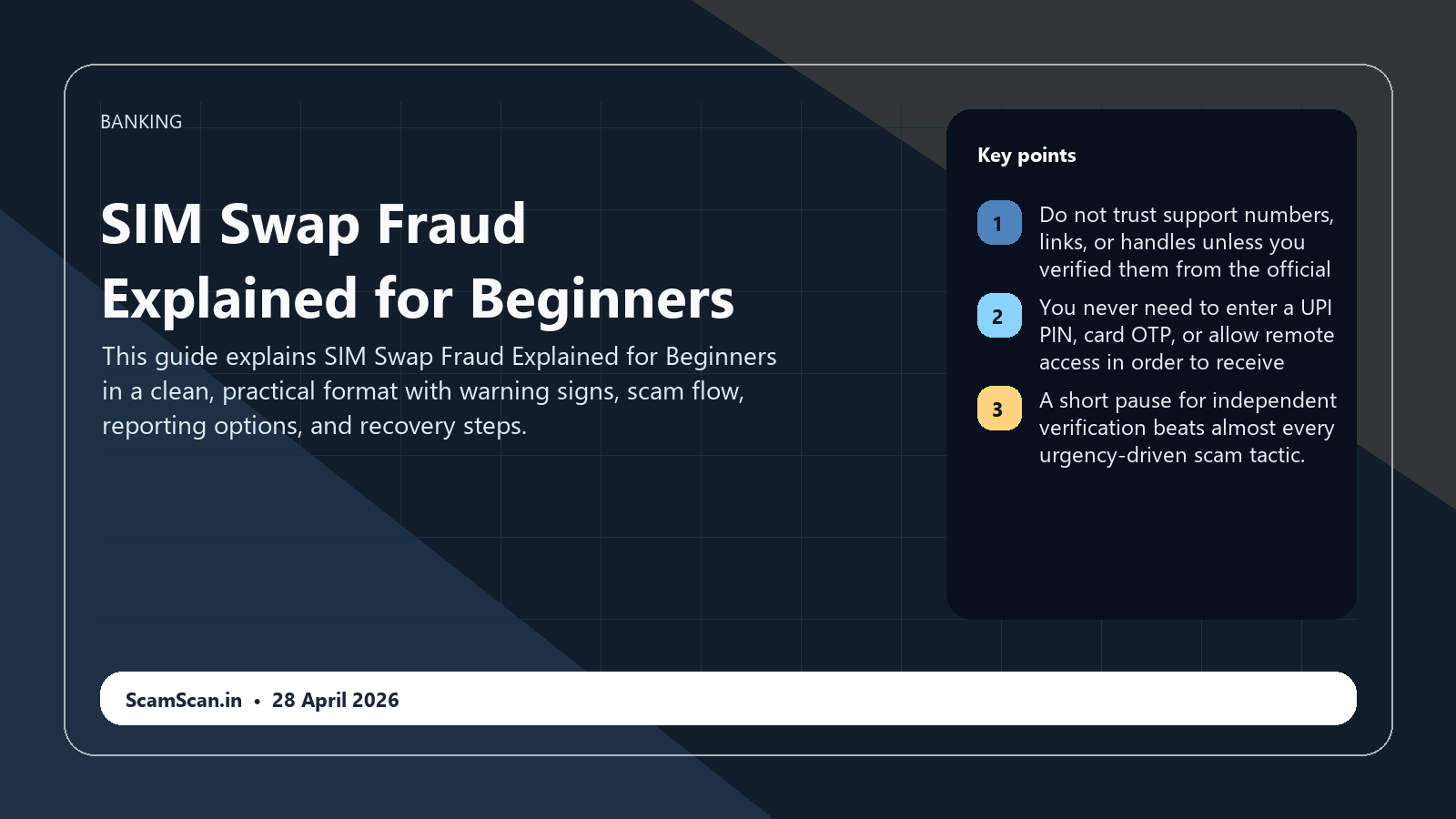
This guide explains SIM Swap Fraud Explained for Beginners in a clean, practical format with warning signs, scam flow, reporting options, and recovery steps.

Updated: 28 April 2026

7 min read EN Banking, card, KYC, and SIM fraud
SIM Swap Fraud Explained for Beginners
Overview

Quick understanding

People usually search for SIM Swap Fraud Explained for Beginners when they are already under pressure. They do not need a vague awareness article. They need a clear answer, a clean process, and a way to avoid the next mistake.

This page is built around that practical need. It treats the issue as part of the broader banking, card, kyc, and sim fraud landscape, then breaks the problem into warning signs, scam mechanics, evidence, and action order.

The format is intentionally easy to scan on mobile: short paragraphs, clear headings, useful image breaks, and direct next steps.

Quick answer

If money, account access, OTPs, UPI PINs, or suspicious links are involved, stop the risk first and move to official reporting quickly.

Context

Why this matters

Fast reporting

If money moved, treat 1930 and cybercrime.gov.in as your first official route.

Image rich

Every guide uses local images, captions, and descriptive alt text.

Action focused

These pages prioritize practical steps over generic awareness fluff.

Red Flags

Top warning signs

SIM Swap Fraud Explained for Beginners warning signs visual
A clean visual summary of the red flags readers should notice first.
  • The attacker pushes urgency before you get time to verify anything properly.
  • A familiar brand, screenshot, support name, or fake proof is used to lower your guard.
  • The conversation quickly moves away from official channels into chat, calls, or links.
  • You are nudged toward a risky action such as OTP sharing, PIN entry, collect approval, or screen access.
  • KYC expiry, SIM block, card freeze, or suspicious debit alerts are common pressure hooks.
Scam Flow

How the scam usually plays out

SIM Swap Fraud Explained for Beginners scam flow visual
This section shows the trust, urgency, action, and damage sequence behind the scam.
  1. Initial hook

    The scam starts with a believable problem, reward, support issue, or urgent alert.

  2. Trust layer

    The attacker uses screenshots, official language, or brand references to reduce suspicion.

  3. Risk action

    The victim is nudged into a harmful step such as PIN entry, login, approval, or document sharing.

  4. Loss stage

    Money moves, access gets captured, or the victim is pulled into a second payment demand.

  5. Aftermath

    The scammer tries to delay reporting, delete traces, or lure the victim into fake recovery help.

Pattern Sample

Copyable scam pattern to recognize

Scammers rarely use perfect language, but they do repeat the same pressure structure. That is why pattern recognition matters more than wording.

Example scam message

Use this only as a pattern sample. Do not reply to the scammer. Save evidence and report instead.

Your issue linked to SIM Swap Fraud Explained for Beginners is under review and needs immediate verification.
Click the link or confirm the screenshot right now or your account / payout may be placed on hold.
To complete the process, share the OTP, approve the request, or verify the payment action.
Action Plan

What to do right now

SIM Swap Fraud Explained for Beginners response visual
An action-first view of what to stop, what to save, and where to report.
  1. Stop the interaction

    Do not keep chatting, clicking, approving, scanning, or sharing access.

  2. Preserve evidence

    Save screenshots, UTRs, numbers, URLs, handles, and timestamps before anything disappears.

  3. Use the official route

    If money moved or credentials were exposed, do not delay 1930 and cybercrime.gov.in.

  4. Alert the bank or payment app

    Log the incident with the bank, card issuer, or payment platform immediately.

  5. Review the device and browser

    Check downloads, extensions, APKs, and suspicious logins or sessions.

  6. Write a clean incident timeline

    A short structured summary improves both complaints and follow-up conversations.

Evidence

What proof to keep

SIM Swap Fraud Explained for Beginners evidence visual
Good evidence makes bank, app, and cybercrime follow-up more structured.
  • Screenshot of the full conversation or alert
  • Phone number, profile handle, email, or support ID
  • Transaction reference, UTR, masked card detail, or payment timestamp
  • The exact URL, QR, APK name, or app name used in the scam
Prevention

How to avoid the same trap again

SIM Swap Fraud Explained for Beginners prevention visual
This final visual keeps the core prevention rules easy to remember.
  • Do not trust support numbers, links, or handles unless you verified them from the official source.
  • You never need to enter a UPI PIN, card OTP, or allow remote access in order to receive money.
  • A short pause for independent verification beats almost every urgency-driven scam tactic.
  • If an offer looks unusually easy or unusually urgent, that tension itself is a warning sign.
FAQ

Common questions

What if I already interacted with the scammer?

Stop engaging, preserve evidence, and move to official reporting if money, credentials, or identity data were exposed.

Is a screenshot enough evidence?

It helps, but stronger complaints also include transaction references, URLs, numbers, handles, and a short timeline.

Should I confront the scammer?

No. That usually increases pressure, confusion, or evidence loss.

Is the ScamScan tool enough on its own?

It helps with quick screening, but real loss or compromise cases still need official reporting and platform escalation.

Related Guides

Read next

Banking, card, KYC, and SIM fraud

फर्जी बैंक SMS कैसे पहचानें? तुरंत चेक करें

फर्जी बैंक SMS कैसे पहचानें? तुरंत चेक करें पर यह साफ, प्रोफेशनल और आसान गाइड है जिसमें खतरे के संकेत, ठगी का तरीका, शिकायत का सही रास्ता, और अगले कदम एक ही जगह मिलते हैं.

Read guide
Banking, card, KYC, and SIM fraud

Credit Card Unauthorized Payment Recovery Guide

This guide explains Credit Card Unauthorized Payment Recovery Guide in a clean, practical format with warning signs, scam flow, reporting options, and recovery steps.

Read guide
Banking, card, KYC, and SIM fraud

PhonePe Fraud Call Se Kaise Bache? Latest Scam Tricks Exposed

PhonePe Fraud Call Se Kaise Bache? Latest Scam Tricks Exposed ko easy Hinglish mein samjho. Is guide mein red flags, scam flow, report route, aur practical next steps clearly diye gaye hain.

Read guide